For lower limb amputees who want to run, the path forward is more defined than most expect: a running-specific prosthesis, a proper fitting by a certified prosthetist, and a graduated training program built around your goals. The path back to running usually starts with fit, then gait training, then a progression plan built around your specific goals. Not a generic plan. Yours. With a running-specific prosthesis and a support team that knows what they’re doing, running again isn’t a long shot for most amputees. It’s a real, achievable thing.
Key Takeaways
- Running-specific prosthetics, including carbon fiber blades, are designed to mimic natural running biomechanics.
- Getting properly fitted by a certified prosthetist is the essential first step before training begins.
- A structured, gradual training program helps amputee runners build strength and confidence safely.
- Understanding your gait and biomechanics reduces injury risk and improves long-term running performance.
- Local and national funding resources exist to help offset the cost of running prosthetics.
- A supportive amputee running community offers coaching, encouragement, and real-world training advice.
- Horton’s Orthotics & Prosthetics serves Arkansas runners with expert fitting and ongoing prosthetic care.
Jump to: What Types of Prosthetics Are Used for Running? | How Do You Get Started? | What Support and Resources Are Available? | Find a Location | FAQ
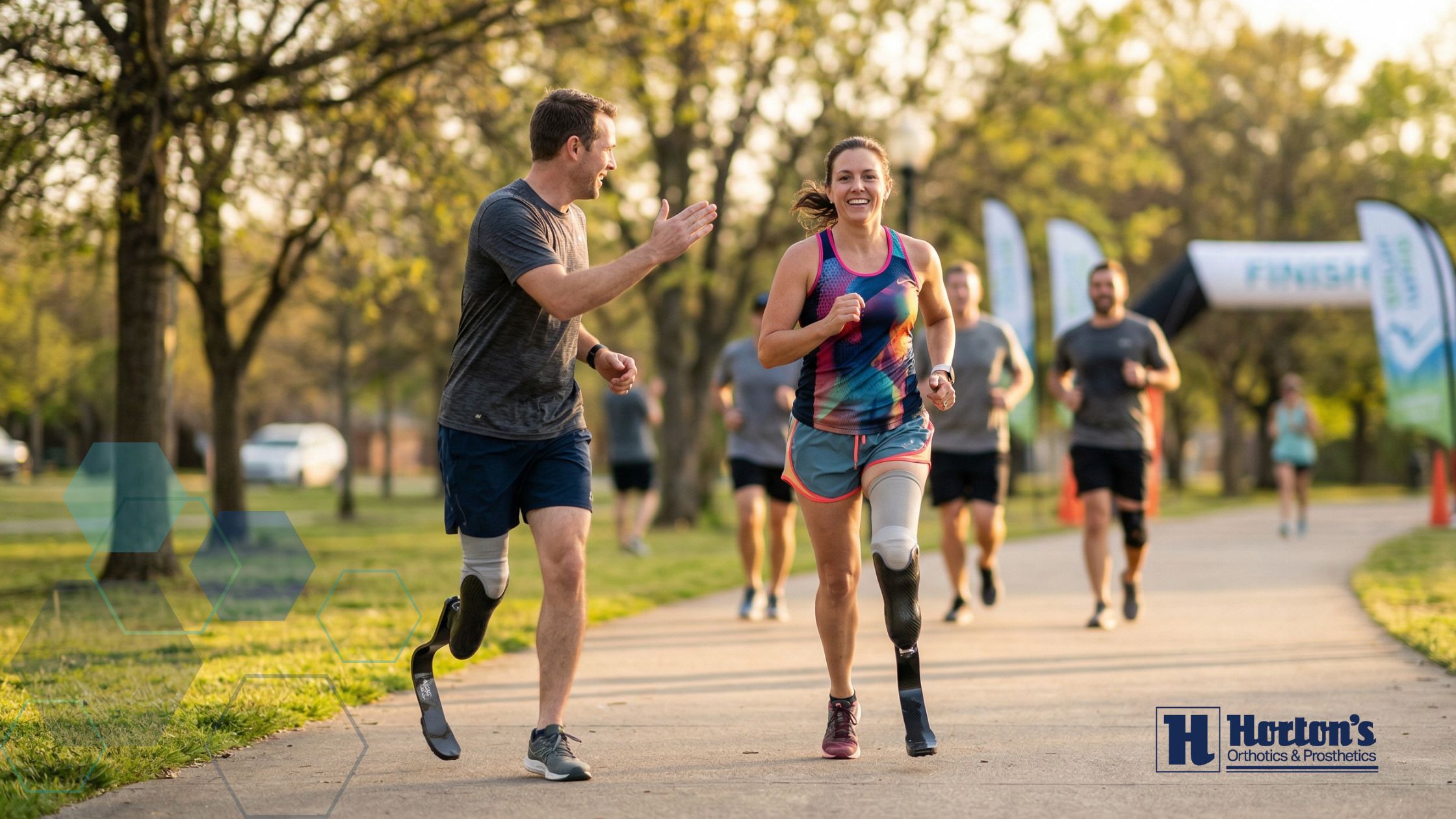
Picture someone crossing a 5K finish line on a carbon fiber blade. Arms up, crowd going a little nuts. Running with prosthetics isn’t some distant thing anymore.
Getting started is honestly less complicated than most people assume, though knowing where to look helps. What follows is the practical stuff: which prosthetics are actually built for running, how fitting works, how to train without breaking yourself in the process, and how to move toward this goal whether you’re a few months post-amputation or you’ve been turning the idea over in your head for a while. If you are wondering what prosthetic you need, how fitting works, and what training should look like, this guide will walk you through it step by step. Horton’s Orthotics & Prosthetics prosthetics services can help you figure out what first step looks like for you specifically.
What Types of Prosthetics Are Used for Running?
Most people who run with a prosthetic use a running-specific prosthesis, often called a blade, because it is built to return energy and support a running stride.
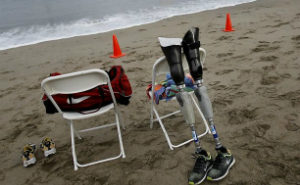
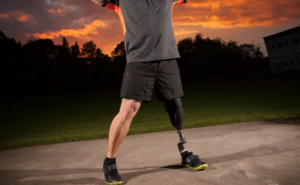
Running-specific prosthetics, or RSPs, are what most people picture when they think of an amputee runner. Carbon fiber blades. A running-specific prosthetic is a prosthetic designed for speed, push-off, and forward motion, not just everyday walking. If you’re exploring a return to running, or pursuing it for the first time after amputation, this is what your care team will talk about.
Running blades aren’t built for everyday life. They’re built for one thing. Your daily prosthetic has a lot of jobs: stability, comfort across different surfaces, a shape that looks natural. An RSP throws all of that out. There’s no ankle joint, no foot shell, nothing pretending to be a foot. Just a curved carbon fiber blade that compresses when you load it and snaps back, pushing energy up through your stride. Basically, it bends under your weight and springs you forward. That recoil is what makes running feel like running again.
What Categories of Running Prosthetics Exist?
It really comes down to two factors: how much of your leg is involved, and the type of running you’re actually trying to get back to. Those two things shape everything else.
| Amputation Level | Prosthetic Type | Key Feature |
|---|---|---|
| Below-knee (transtibial) | Running blade (RSP) | Carbon fiber energy return |
| Above-knee (transfemoral) | RSP + prosthetic knee | Requires gait training for knee control |
| Partial foot | Foot shell or partial RSP | Custom to residual limb length |
Below-knee (transtibial) means the knee joint is still intact. Above-knee (transfemoral) means the prosthesis also has to account for the knee.
Below-knee (transtibial) blades are what most people start with. You’ll see names like the Össur Cheetah, Freedom Innovations Catapult, and Ottobock Taleo come up often. These aren’t interchangeable. Each blade has a profile tuned to a particular running style and body weight. Which model you end up with matters, but so does the fit and prescription behind it.
Above-knee (transfemoral) runners need an RSP paired with a prosthetic knee component. It’s a more complex system, and learning to control that knee through a running gait takes real time with your clinical team.
Partial foot amputees have options too. Depending on the length and shape of your residual limb, a partial RSP or custom foot shell can restore the toe-off mechanics that running requires.
No matter where the amputation is, socket fit is what everything else builds on. If the blade doesn’t sit right on your residual limb, you’re going to feel it in your performance, and potentially in your body. The Amputee Guide to Proper Fit is worth reading. It walks through what a well-fitted prosthetic should actually feel like, and what to watch for when something’s off.
One thing that trips people up: athletic prosthetics function differently from everyday devices in design, materials, and intended use. They usually require a separate prescription evaluation, not just a note on your existing one. A lot of active patients end up with two prostheses, one for daily life and one built around their sport.
Knowing your category is step one. The next question is more practical. What do you actually do with that information?
How Do You Get Started Running with a Prosthetic?
Most people start by getting evaluated for a running prosthesis, then move into gait training and a gradual walk-run program.
Getting into running after amputation isn’t something that happens overnight, and honestly, it shouldn’t. Most amputees start by working with a prosthetist to get fitted with a running-specific prosthesis and going through some initial gait training. From there, the path forward is real and reachable. It’s also shaped around what you’re trying to do, not some standard protocol built for the average patient. There will be multiple appointments. That’s just how it works, and it’s fine. Building the right foundation matters more than moving fast.
What Does the Getting Started Process Look Like?
Step 1: Consult your prosthetist. This first appointment is doing more work than it might seem. Your prosthetist is building a picture of you specifically: the shape and condition of your residual limb, where your activity level sits right now, and what you’re actually trying to get back to doing. Not a template. Not a list pulled from a brochure. Your situation. That picture is what drives every recommendation that follows, including which running prosthesis makes sense for you. These devices are not interchangeable. Something that feels like an extension of one runner’s body can feel completely off for another person with nearly identical measurements. The consultation isn’t a box you check before the real appointment. It is the real appointment.
Step 2: Get fitted properly. Comfort matters, but fit is doing something bigger than that. It shapes your mechanics. It determines how your body absorbs load every single stride. Here’s what the research shows: for unilateral below-knee amputee runners, the intact limb takes on significantly higher loading rates than the prosthetic side. A 2014 study published through NIH documents this loading asymmetry in detail. Ramp your training too fast, or let the fit stay even slightly off, and that’s where injuries start showing up. Not on the prosthetic side. On the other one. Getting fit right from the beginning is a lot cheaper than chasing the problem later.
Step 3: Complete gait training. Walking and running are not the same movement. Your body knows how to do one. It has to learn the other, with new equipment, from scratch. Gait training is that learning process. It’s how you figure out what your stride actually looks like with a prosthesis, where the compensations are creeping in, and what needs to adjust before those compensations turn into pain. A physical therapist or certified prosthetist watching you move gives you information you simply cannot get on your own. Think of it as the gap between having the right tool and actually knowing how to use it. People who skip this step almost always end up spending more time on it later, just under worse circumstances.
Step 4: Follow a structured training program. Walk-run intervals first, then gradual progression. Trying to jump ahead too fast is probably the most common mistake people make when starting out with a running prosthesis. The motivation is there, which is great, but the tissue and the mechanics need time to catch up. Horton’s Orthotics & Prosthetics has Adaptive Fitness Training resources built specifically for prosthetic users, practical and realistic, not something borrowed from a generic running plan.
Step 5: Set a goal that actually means something to you. A 5K, a trail run, an Arkansas adaptive sports competition. The specific thing matters less than whether it’s yours. When you have a real target, something you actually care about, it’s a lot easier to keep showing up on the training days that feel hard. Generic motivation fades. A goal with personal weight doesn’t.
Does Running Performance Improve Over Time?
It does. And the improvement is real, not just incremental. Energy efficiency goes up as your body adapts to the RSP and your mechanics get sharper. A 2022 study on metabolic cost in amputee runners confirms that with proper training and equipment, amputee runners can reach competitive performance levels. The early weeks feel demanding because your neuromuscular system is learning something genuinely new. But that adaptation curve flattens faster than most people expect, and runners consistently say it starts to feel natural sooner than they thought it would.
What Should the First Few Weeks Feel Like?
Those first weeks are often awkward. Tiring in a way that catches people off guard. More mentally demanding than physically, sometimes. None of that means something’s wrong. It’s just what it feels like to rewire a movement pattern while your body is simultaneously getting stronger. Two things happening at once, and neither one is subtle. Most people use the word “adjustment.” That’s fair. But a lot of those same people also mention the moment things started to click, and how much sooner it came than they expected. The hard part is real. It’s also not as long as it looks from the beginning.
Who’s in your corner during that stretch matters. That’s what we’re getting into next.
What Support and Resources Are Available to Amputee Runners?
The hardest part usually isn’t the training. It’s not knowing who to call, or whether your questions are even the right ones yet. If you’re somewhere in that early fog, whether you’ve just started thinking about running again or you’re a few months in and hitting walls, people have been through exactly this and are reachable.
Horton’s Orthotics & Prosthetics runs the A.B.L.E. (Amputees Beyond Life’s Expectations) program, which connects amputees with peer ambassadors who’ve actually done this. Someone who sat in the same fitting chair, had the same doubts about their first blade run, and kept going anyway. They can tell you what that progression looked like in real terms, not in the way a brochure does.
If you’re still trying to sort out what kind of device you’d even want, or how activity goals factor into long-term care decisions, Horton’s Orthotics & Prosthetics has education resources that walk through those questions without pushing you toward any particular answer. Useful if you’re the type who wants to understand the landscape before committing to anything.
Running-specific prosthetics aren’t cheap, and that’s worth saying plainly. The Challenged Athletes Foundation has grant programs that cover adaptive equipment, coaching, and competition costs. Thousands of athletes have used them to access gear that wouldn’t have been financially realistic otherwise. It’s worth looking into before you write off a carbon fiber blade as out of reach.
Eight locations spread across Arkansas. For most people, that means one isn’t far. And when you’re already managing a lot, that proximity matters more than it sounds. The prosthetists at Horton’s have worked with plenty of patients who aren’t just trying to get around. They’re trying to get back to something specific. Running. Sport. A life that doesn’t feel like it got smaller. So if you want to talk running blades or sport-specific fitting without sitting through a generic mobility checklist first, you’ll find people here who actually want that conversation. All eight offices are listed below.
Find a Horton’s Near You
Horton’s has eight locations across Arkansas. Central Arkansas, the Delta, the River Valley, up toward the Ozarks. Chances are there’s a clinic closer to you than you’d expect.
- Little Rock | 5220 West 12th St., Little Rock, AR 72204 | (501) 683-8889
- North Little Rock | 4020 Richards Rd., Suite D, North Little Rock, AR 72117 | (501) 945-0404
- Bryant | 605 W Commerce St., Bryant, AR 72022 | (501) 847-6999
- Conway | 635 Dave Ward Drive, Suite 103, Conway, AR 72034 | (501) 406-8510
- Searcy | 710 Marion St., Suite 304, Searcy, AR 72143 | (501) 268-2272
- Jonesboro | 2760 Browns Lane, Suite A, Jonesboro, AR 72401 | (870) 641-0444
- Fort Smith | 2909 South 66th Street, Fort Smith, AR 72903 | (479) 452-3959
- Batesville | 1699 Harrison Street, Suite E, Batesville, AR 72501 | (870) 569-0033
Call the nearest location or visit their office page to see what that clinic can do for you.
Frequently Asked Questions
Do I Need a Separate Prosthetic for Running?
Yes, most people need a running-specific prosthesis separate from their everyday device. Everyday prosthetics are built for walking and daily activity, not the energy return and forward propulsion that running demands. A separate evaluation and prescription from your prosthetist is typically required to get the right fit for running.
Can I Run with a Below-Knee Prosthetic?
Yes. Plenty of amputee runners, both recreational and competitive, use carbon fiber running blades built specifically for the sport. If your amputation is below the knee, the learning curve tends to be shorter than most people anticipate going in. It’s not a small thing to take on, but it’s genuinely achievable, and a lot of people surprise themselves.
How Much Does a Running Prosthetic Cost?
Running prosthetics can range from around $5,000 to $18,000 or more depending on the device, the manufacturer, and what your specific fit ends up requiring. Insurance is where things get complicated. Coverage varies pretty significantly based on your plan and how your activity level is documented. It’s worth having a real conversation with your prosthetist early on, both about which devices make sense for you and about what financial options are actually on the table.
How Long Does It Take to Learn to Run with a Prosthetic?
Honestly, it varies a lot. Some people are finding their stride in a few weeks. For others it takes several months to really build confidence and dial in their form. Your fitness going in, your amputation level, how consistently you’re training, all of it plays a role. Progress tends to be uneven rather than a clean upward line. What does seem to help is having both a prosthetist and a physical therapist in your corner at the same time. When those two are working together around your goals, things tend to click faster.
Does Insurance Cover Running Prosthetics?
It depends on your specific plan, your documented functional level, and how your clinical team makes the case for medical necessity. Some plans cover running prosthetics for the right candidates; others treat them as recreational devices and won’t. Your prosthetist can help you understand what your benefits actually say and advocate for you when it counts.
Ready to Run? Here Is How to Take the Next Step.
Running after amputation is real. People do it every day, at every level, and the right device and the right team matter more than most people realize going in.
> Note: Whether running is the right goal for you depends on your specific amputation level, overall health, and medical history. Every patient is different. Talk to your doctor before pursuing a prosthetic fitting or starting a new exercise program. The care team at Horton’s Orthotics & Prosthetics can work alongside your physician to make sure any plan fits your individual situation.
Horton’s Orthotics & Prosthetics has eight locations across Arkansas: Conway, Little Rock, North Little Rock, Bryant, Searcy, Jonesboro, Fort Smith, and Batesville. Find the one closest to you, book an evaluation, and just start talking. Your goals deserve more than a waiting room and a pamphlet. They deserve an actual plan.